Environmental journalists play a vital role in documenting deforestation, land conflicts, climate change, and other issues that directly affect communities and public accountability. Yet their work often takes place under difficult and risky conditions.
A new study released by the Cambodian Journalists Alliance Association (CamboJA) on 30 April provides one of the most detailed snapshots to date of environmental journalism in Cambodia, examining what journalists report on, where reporting takes place, the risks they face, and the support they need.
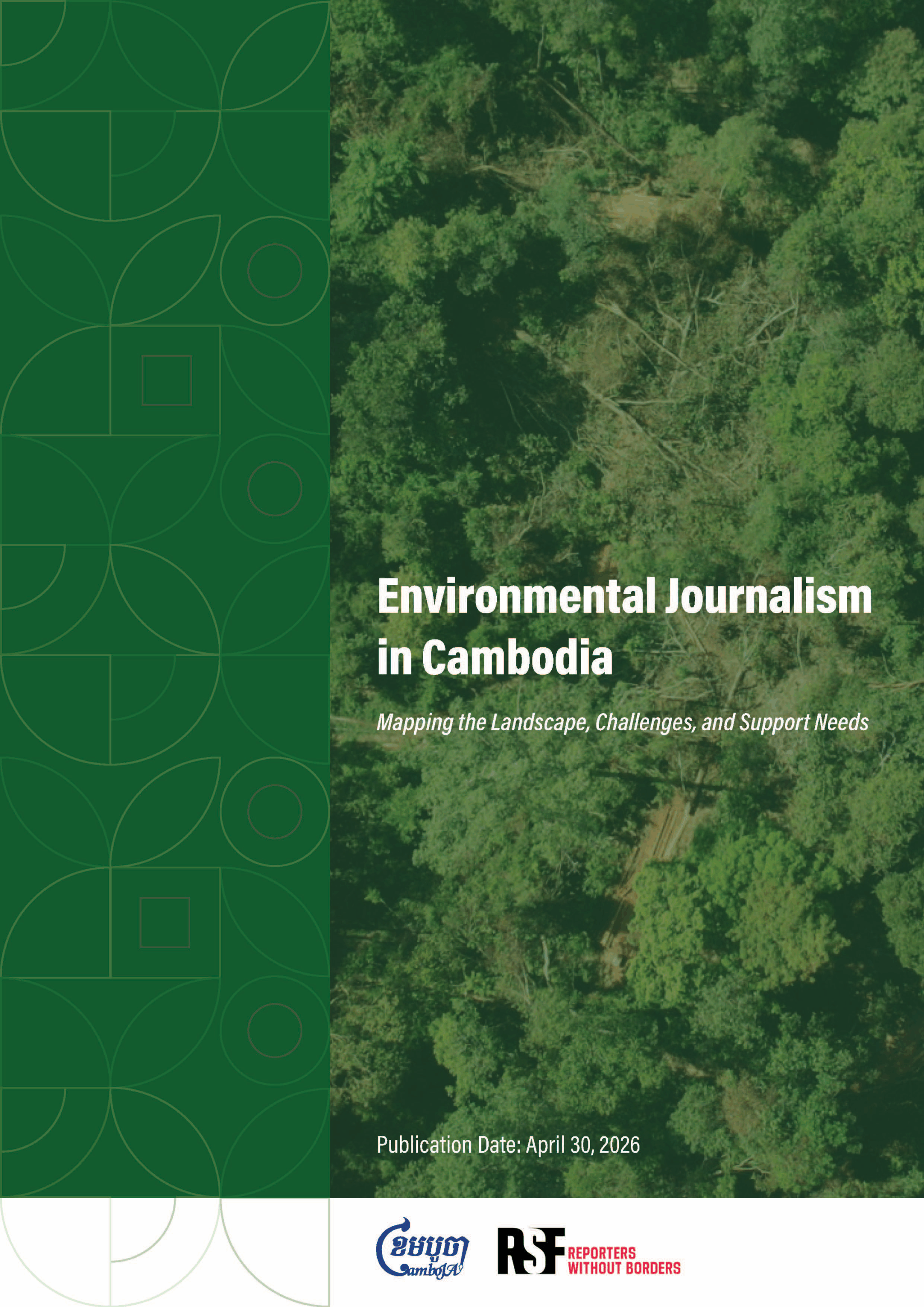
Titled Environmental Journalism in Cambodia: Mapping the Landscape, Challenges, and Support Needs, the study draws on a national survey of 74 journalists, key informant interviews, and a focus group discussion with reporters from Phnom Penh and across the provinces.
Key Takeaways
1. Forest and land issues dominate coverage
The most frequently reported topics are deforestation, land grabs, climate change, indigenous rights, mining, wildlife, and hydropower development. This reflects the close link between environmental reporting and Cambodia’s natural resource governance challenges.
2. Provincial reporting is critical
Environmental reporting is concentrated in provinces where forests, land disputes, and extraction activities are most visible, including northeastern and other resource-rich areas. Journalists outside Phnom Penh often provide direct ground-level reporting from affected communities.
3. Safety risks remain a serious concern
A majority of respondents reported feeling unsafe while covering environmental issues. The most common risks include intimidation, denial of access to information or reporting locations, legal threats, and online harassment.
4. Journalists need more support
Respondents highlighted the need for legal assistance, safety training, environmental reporting skills, better equipment, and stronger professional networks.
5. Women remain underrepresented
The study found that women journalists remain a smaller share of environmental reporters and may face additional barriers related to safety, mobility, and unequal opportunities in field reporting.
Key Recommendations
The study highlights the need for coordinated action among government institutions, media organizations, journalist associations, civil society groups, and international development partners to strengthen environmental journalism in Cambodia.
Key recommendations include:
- Reform the legal framework, notably the Penal Code sections related to incitement and defamation, so that journalists can do their work without fear of abusive and bogus prosecutions.
- Improving access to environmental information, including the adoption of the long-delayed Law on Access to Information in line with international human rights standards.
- Establish an independent press council, with independence guaranteed in its statutes, to serve as a priority mechanism for resolving disputes involving government officials, private sector actors, the public, and the press. The fundings of the press council should be sufficient, stable and diversified.
- Strengthening protection mechanisms for journalists, including legal assistance, safety training, and accountability for officials who obstruct journalists’ reporting activities.
- Enhancing newsroom safety protocols and gender-inclusive practices to support journalists reporting on environmental issues.
- Expanding training programs and capacity development initiatives, particularly in investigative reporting, environmental governance, and digital reporting tools.
- Supporting professional collaboration and networks among environmental journalists, particularly for freelancers and journalists working in provincial areas.
- Providing resources and reporting support, including story grants and equipment, to enable journalists to conduct in-depth environmental investigations.
Strengthening environmental journalism is essential for promoting transparency, accountability, and informed public debate on environmental issues in Cambodia. By improving the safety, capacity, and professional support systems for journalists, stakeholders can help ensure that environmental reporting continues to play a vital role in documenting environmental change and contributing to sustainable development.
CamboJA hopes the findings will contribute to stronger protections for journalists and greater support for public-interest reporting in Cambodia.
Download the English version of the report here: Environmental Journalism in Cambodia: Mapping the Landscape, Challenges, and Support Needs
A Khmer-language version of the report will be made available soon.